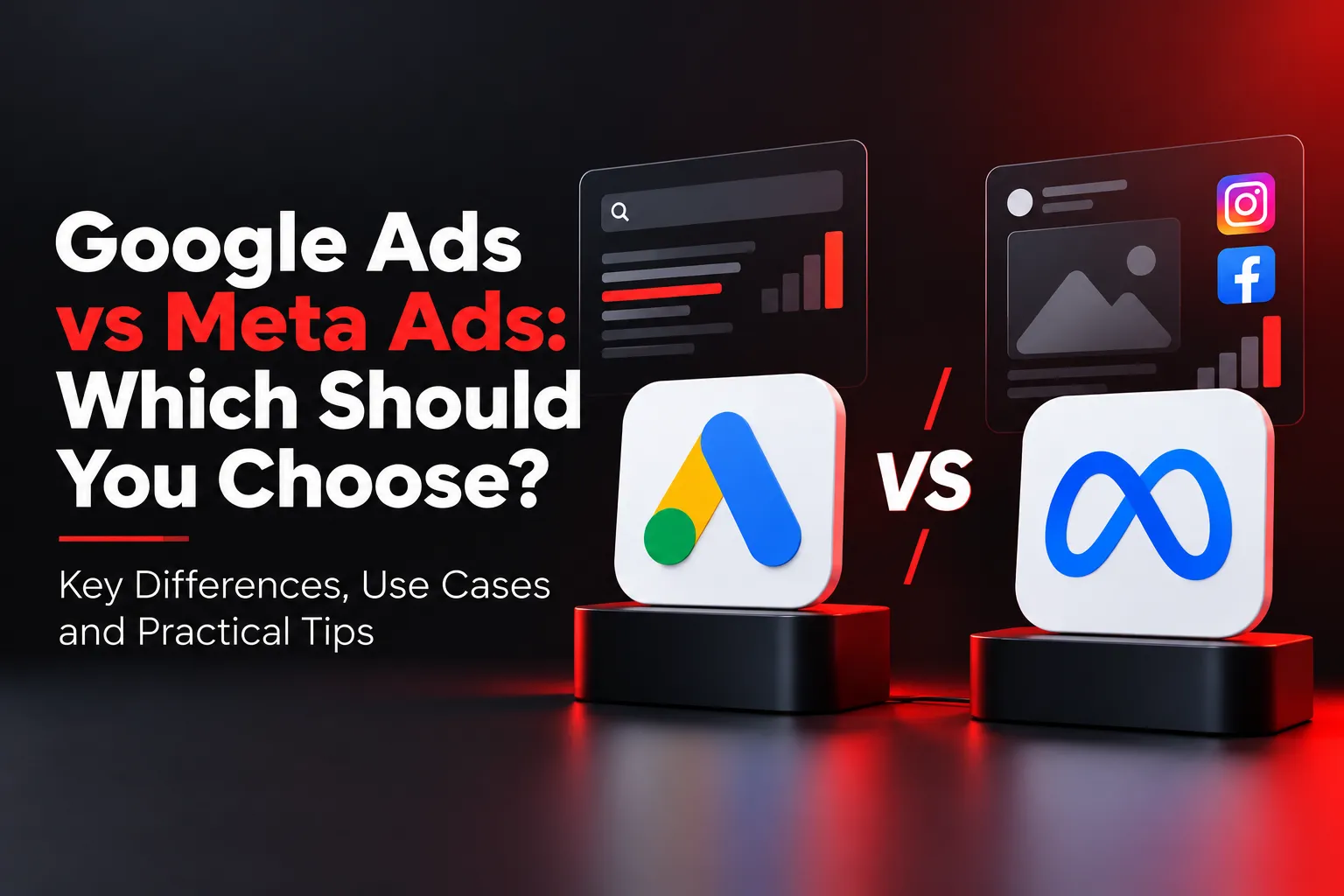
Google Ads and Meta Ads can both generate leads and sales, but they usually reach customers in different situations.
The simple version is this:
Google Search is often strongest when people are already looking for what you sell. Meta Ads is often strongest when you need to attract attention and show people why they should care.
Neither platform is automatically better. The right choice depends on how customers discover your offer, whether search demand already exists, how visual the product is and what happens after someone clicks.
First: Google Ads Is More Than Google Search
Google Ads includes Search, Shopping, Display, Video, Performance Max and other campaign types.
For this comparison, however, we are mainly looking at Google Search Ads vs Meta Ads, because this is often the most useful decision for a small or growing business choosing its first paid acquisition channel.
Google Search lets advertisers reach people while they are actively searching for relevant products and services.
Meta Ads usually reaches people in a different context: while they are browsing Facebook, Instagram and other Meta placements.
That difference matters.
When Google Search Makes More Sense
Imagine someone searches for “accountant for a company in Warsaw” or “emergency plumber near me”.
The customer already understands the problem and is looking for a solution. That is where Google Search can be particularly useful.
It often makes sense when people already search for your service, the need is specific, commercial intent is clear and you have a relevant page to send the visitor to.
This is common for local services, professional services, repairs, legal services, healthcare and many B2B offers.
But search intent alone does not guarantee good results. If clicks are expensive, the landing page is weak or leads do not become customers, the campaign can still be unprofitable.
When Meta Ads Makes More Sense
Meta Ads often starts one step earlier.
Someone scrolling Instagram may not be searching for your product at all. The advertisement has to win attention and explain why the offer is relevant.
This can work particularly well when a product is easy to demonstrate visually, customers do not normally search for the exact solution, or the offer needs some explanation before someone becomes interested.
Think about fashion, beauty, ecommerce products, events or a product with a clear visual transformation.
Here, the creative matters a lot. A strong image, video or message can introduce the problem and the solution before the customer has decided to search for it.
That also means Meta usually needs ongoing creative testing. One advertisement is rarely enough to judge the whole channel.
The Biggest Difference Is Customer Intent
The most useful way to think about the two platforms is not Google = expensive, Meta = cheap.
It is this: Google Search often responds to existing demand. Meta can help you reach people before that demand becomes a search.
Someone searching for a specific service may be relatively close to contacting a provider. Someone seeing a product for the first time on Instagram may need more information, more exposure or more time before buying.
That is why the same business can get very different results from the two platforms without either platform being “bad”.
Do Not Choose Based on CPC Alone
A common comparison is a higher Google CPC versus a lower Meta CPC. It may look as if the cheaper platform is obviously better.
But CPC does not tell you what happens after the click.
Suppose the Google traffic generates more qualified enquiries while the cheaper Meta traffic produces mostly weak leads. Google could still have the better business result.
The important path is:
ad spend → relevant traffic → qualified lead or purchase → customer → revenue
The cheapest click is not necessarily the cheapest customer. Both platforms should ultimately be evaluated against business outcomes rather than traffic metrics alone.
When Using Both Channels Makes Sense
Google and Meta do not necessarily compete with each other.
A potential customer might first see a business on Instagram and later search for the service on Google. Another customer may start directly with Google Search.
Using both channels becomes more reasonable when the business has enough budget to test them properly, tracking works, the offer is already reasonably clear and there is enough operational capacity to handle additional leads or orders.
But a small business does not need to launch both immediately. If the budget is limited, it is often better to choose the channel with the strongest business logic, test it properly and then add the second one for a specific reason.
A Simple Way to Choose
Ask these five questions:
- Are people already searching for your product or service? If yes, Google Search deserves serious consideration.
- Does the product need to be seen to be understood? If yes, Meta may have an advantage.
- Is the need urgent and specific? Search often fits this behaviour well.
- Can you regularly produce and test good creative? This is particularly important for Meta.
- Can you track real leads or sales after the click? Without this, comparing either platform becomes much harder.
You do not need a perfect answer to every question. The goal is simply to understand which channel better matches the way your customers actually buy.
Google Ads or Meta Ads?
For many businesses, the decision comes down to demand.
If customers already know what they need and actively search for it, Google Search may be the better first test.
If the product needs to attract attention, demonstrate value or reach customers before they start searching, Meta Ads may be the stronger starting point.
And when both types of behaviour exist, using both platforms can make sense.
The useful question is not “Which advertising platform is better?” It is “Which platform matches how customers discover and buy our offer?”
If customers are already searching for what you sell, explore Leybort’s Google Ads management service.
If your offer depends more on visual discovery through Facebook and Instagram, explore our Meta Ads management service.
FAQ
Is Google Ads better than Meta Ads for small businesses?
Not universally. Google Search can be a strong fit when customers already search for the offer. Meta can be stronger when the business first needs to attract attention or demonstrate the product.
Which is cheaper: Google Ads or Meta Ads?
There is no useful universal answer. CPC, competition and conversion performance differ by market and business. Compare the cost of qualified leads or customers rather than clicks alone.
Can Google Ads and Meta Ads work together?
Yes. They can reach customers at different stages of the buying process, provided the business has enough budget and reliable tracking to evaluate both.
Insights from Our Experts
Explore our latest articles on digital marketing strategies.